122 Cathy Read Art

Vibrant dynamic architectural art
Artists at Hogshaw Farm

Cathy Read Art image

Cathy Read uses watercolours and acrylic inks to transform familiar architecture into art. Cathy brings urban landscapes to vibrant life. From the bustle of Victoria Station to the grandeur of Towcester Race Course, She captures the essence of Britain’s cities in her distinctive style. Meet the artist, discover her creative process, and browse original paintings, prints, and cards featuring scenes from London, Manchester, Oxford, and local landmarks of Buckingham and Towcester.

Venue

Hogshaw Farm & Wildlife Park
Claydon Road
Hogshaw
MK18 3LA

Becky Paton
Alexandra Buckle
Paul Acton
Kathryn Acton
Becky Gouverneur
Kate Whiting Designs
Hilary Audus
Victoria Stanway
Oliver Winconek
Life Beyond Words

What 3 words location: spare.horseshoe.asset

Tel: 07818 240116
Email: cathy@cathyreadart.com
Instagram: cathyreadart
Facebook: CathyReadArtPortfolio

Website: https://cathyreadart.com/bucks-art-weeks

Special information:
Access for wheelchair users

Demonstrations

Refreshments

Parking
Venue suitable for visits by school parties by appointment

Art forms: Mixed media

Opening Dates and Times

June 2026

SaSuMoTuWeThFr6789101112131415161718192021
Weekdays: 10am – 4.30pm
Saturdays: 10am – 4.30pm
Sundays: 10am – 4.30pm

Explore member galleries

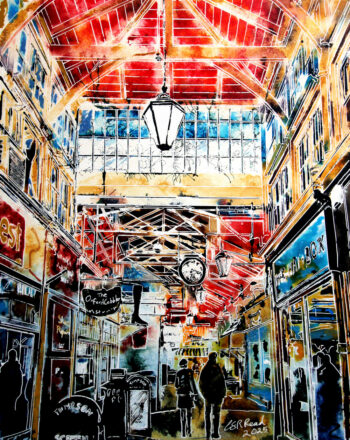
Covered Market Oxford. Walking into a Living Novel. This could be a scene from a Dickensian novel. With a lady wearing a long skirt walking beside a gentleman in silhouette. Everything about the painting screams history and old architecture. It’s easy to miss the covered market in Oxford, but once you find it, it’s like stepping back in time. How far back, you may wonder? I’ll tell you, but first let me show you how I see it. Oxford’s covered market is a hidden oasis of small shops and boutiques, alongside traditional butchers and greengrocers. In an age of supermarkets, these specialist shops with their traditional functions, are harder to find. Small towns and regions hold on to some them, but the competition from the big guys is fierce. Fortunately, human nature is such that small specialist providers will always spring up. This is a place that encourages niche shops.  Created in a time before literacy was widespread. The boot, as a symbol for the cobblers, caught my eye. Words are good, but with a symbol as clear as a boot, you know it’s a cobbler, and although this may be a more recent addition, such devices were once all that was required and still used, even today. One other shop can be identified, The hat box, not  common sight in the modern world. In the distance is Bonners, the last of many greengrocer’s. Sadly it closed in December 2025. Most of the shops retain the iron rails outside. Used for hanging goods on display which are taken down at the end of the day. Living with History My first encounter with the covered market was during my student days. It was a good place to get fruit and veg, and the first time I had ever seen game and feathered birds hung up outside the many butchers shops. Something of a shock to me as game birds weren’t common where I grew up. After shopping, there followed a heavily laden bike ride down St Aldates and the Abingdon road. It was often slow, wobbly, but, mercifully, mostly downhill. The Covered market building itself, features nothing especially different from spaces built all over Britain. That red roof gives it a festive feel in the depth of winter or height of summer. It’s a communal space, away from the whims of climate. An oasis in the summer and shelter from the rain and snow come winter, or just another shortcut from one place to another. When did it all begin? According to the Covered Market’s website, “The building dates back to the 1770s and has a long, varied and interesting heritage. In 1772, the original market committee accepted an estimate for nine hundred and sixteen pounds and ten shillings for the building of twenty butchers shops. John Gwynn, the architect for Magdalen Bridge, drew up the plans and designed the High Street frontage. Twenty more shops soon followed and grew into the delight it is now.” Find out more. More about the painting A visually busy scene, I regretted started it on many occasions. With so many windows, it seemed to take forever to reach the painting stage. Few people are about. The central couple walk on, taking in the scene. Oblivious to their reflections, ghosts of themselves follow invisible paths, all adding to the paintings, Dickensian feel. Of all things, it’s the roof that steals the your attention, the colour, the shape, the light and the glorious clock telling us it’s 3:30pm. The whole composition draws you along a path inwards. Towards the couple and beyond to the yellow glow around Bonners the greengrocers. We’re walking through the covered market without taking a single step. Which way would you like to go now?
Cathy Read Art

Venues nearby